Thursday, April 06, 2006

What, no stega?

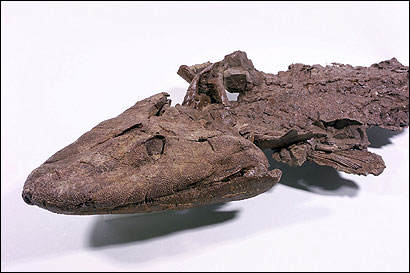
It may take a particular kind of person to apreciate this, but I think that a new Devonian sarcopterigian fish is actually kind of cute, if not adorable by fossil fish standards1. Perhaps most important is that it isn't a dark grey smear on a dull grey rock (or affectionately known as a Smudgeichthys).
It's a great specimen, but I do have a problem with the name that it was givin. The name is perfectly valid, it just won't make things any easier for students of paleontology. The creatures that students typically memorize as transitional between fish and amphibians are Eusthenopteron, Ventostega, Acanthostega and Ichthyostega. The new fish has been dubbed Tiktaalik roseae. Tiktaalik is from the Inuit word for a large freshwater fish and roseae refers to someone who fronted the money for the expedition to Ellesmere Island.

1. Fleshed out, the creature was probably much more fearsome and ugly than cute and it likely tasted like shark meat.

Tuesday, April 04, 2006

Continued Adventures in AZ

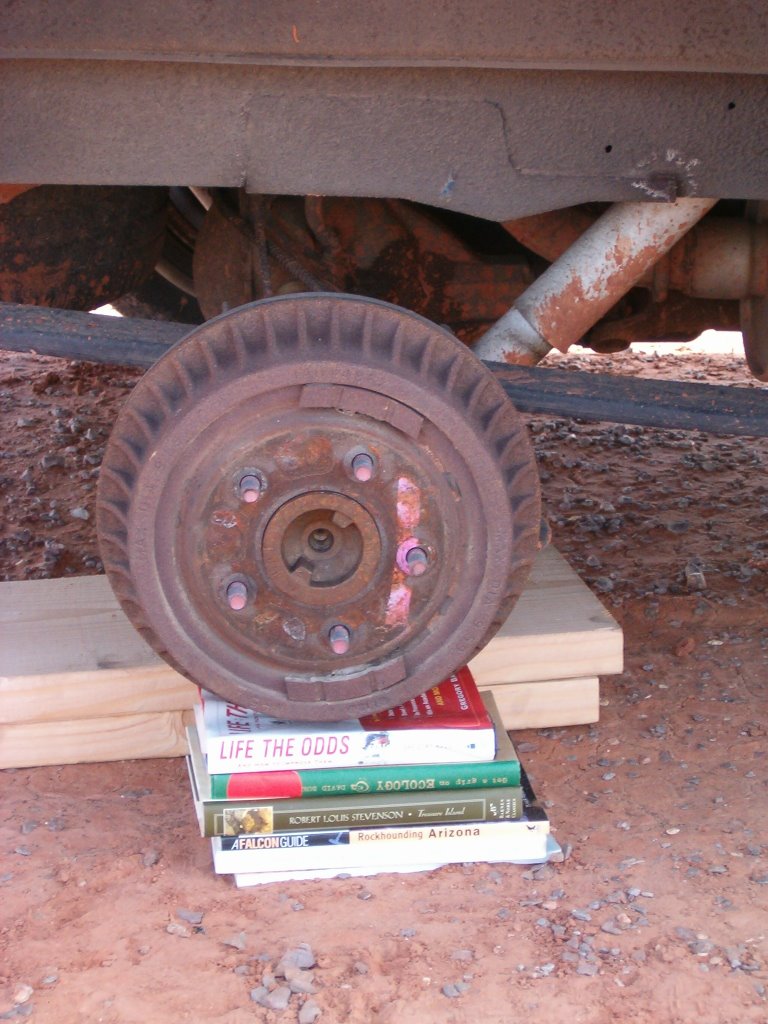
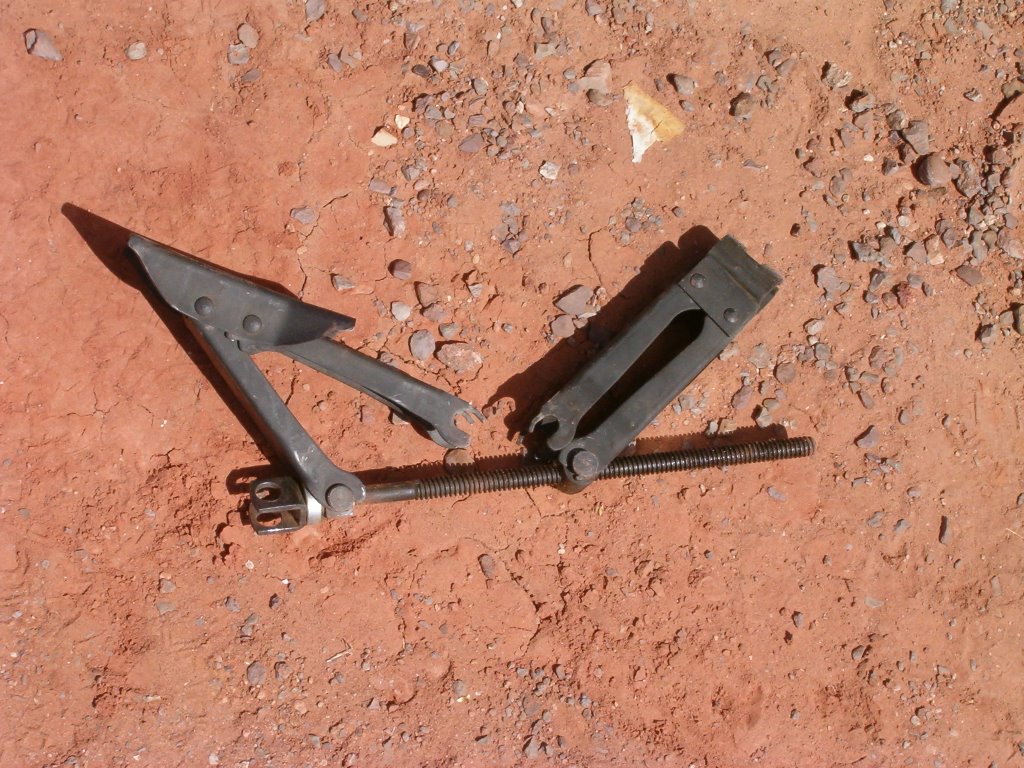
How strong is your education? Even a small part of mine can hold up a car. I'll explain: The first of the events of the last couple of weeks was a flat tire in the middle of the desert. Changing the tire was one big, long lesson in the benefits of redundancy. First of all, it was a good thing that I had a spare tire; second, it was fortunate that I had a spare jack since the first one couldn't withstand the weight of the van and snapped like a steel trap. No fingers were lost but itcertainly didn't do anything to improve my calm. Also, in order to actually hold up the car while I put some boards under the new jack, I found out that a stack of books is really effective. I just now have two deep grooves in the gover of the top book.


the broken Jack.


Thankfully, this was the most major setback I had during the entire two week period. The only other setback was the fact that I spent the first week in an area completely devoid of body fossils. I base where I go searching on data from UC Berkeley's paleo collection database. According to that database, a bonebed containing thousands of specimens was excavated at this particular locality. If there was a bonebed there, then it contained the only fossils around, since I didn't find a single shard of bone for the 7 days I was there. Not only that, but there were only two or three small pieces of petrified wood in an area covering several square miles.
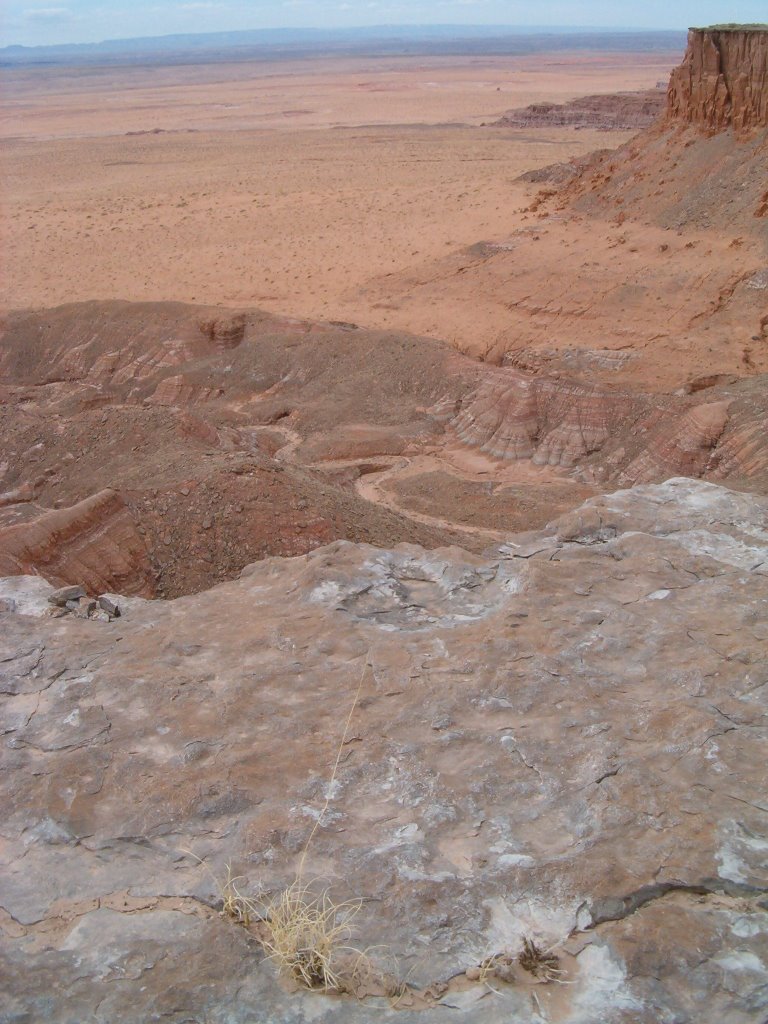
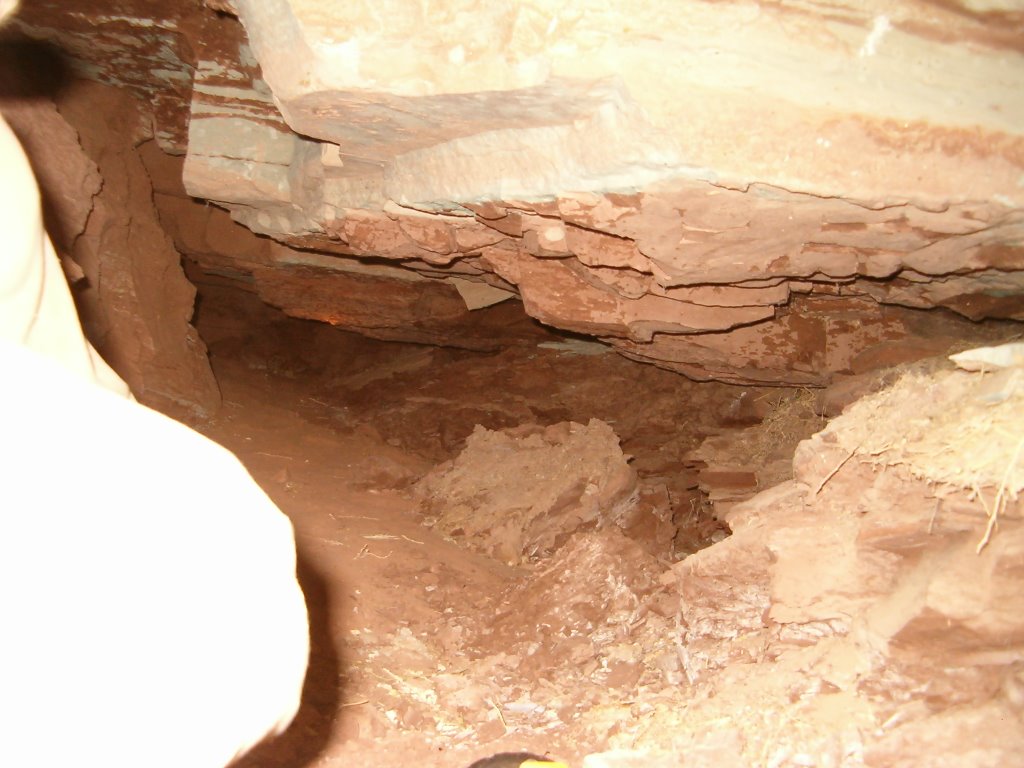
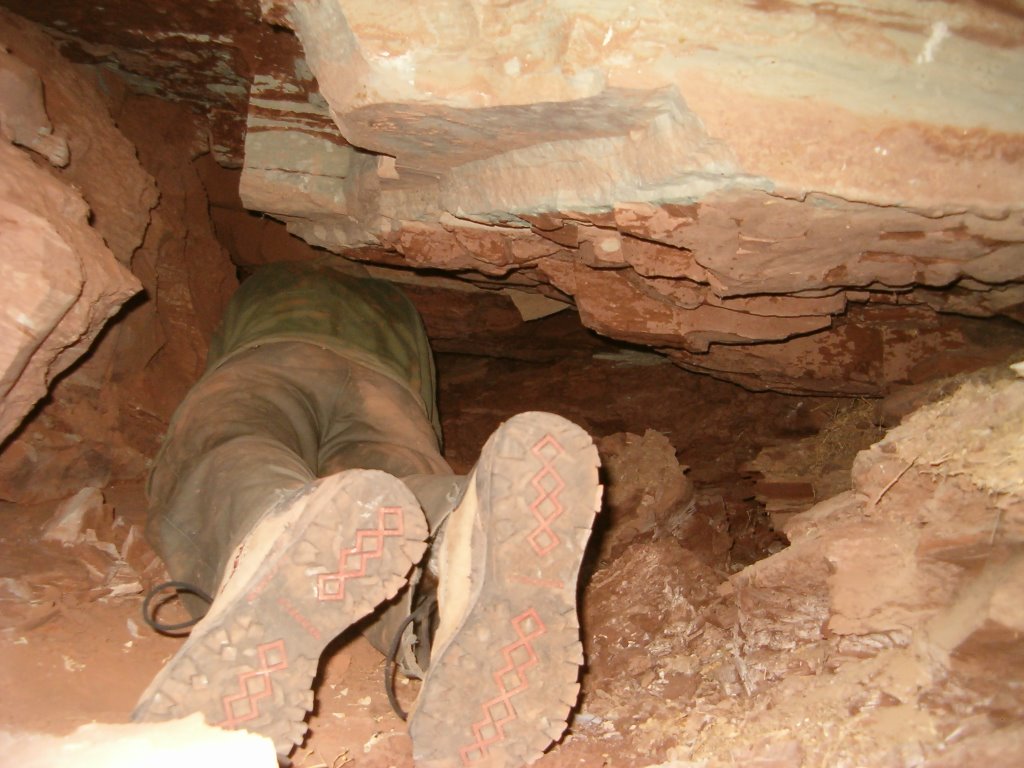
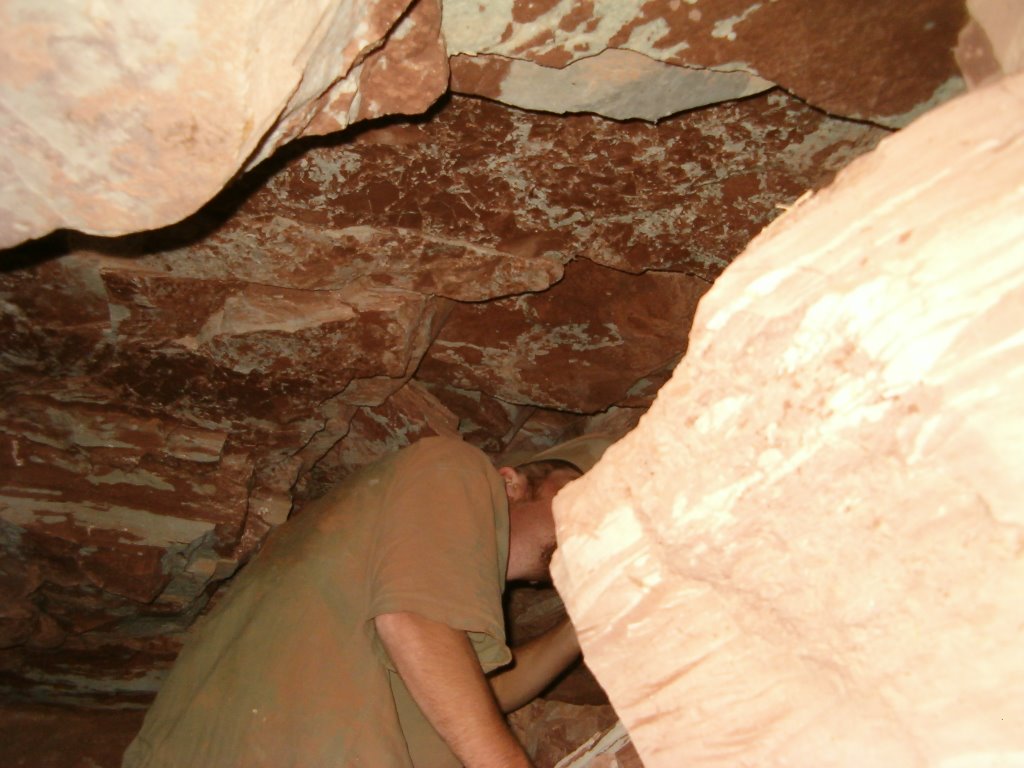
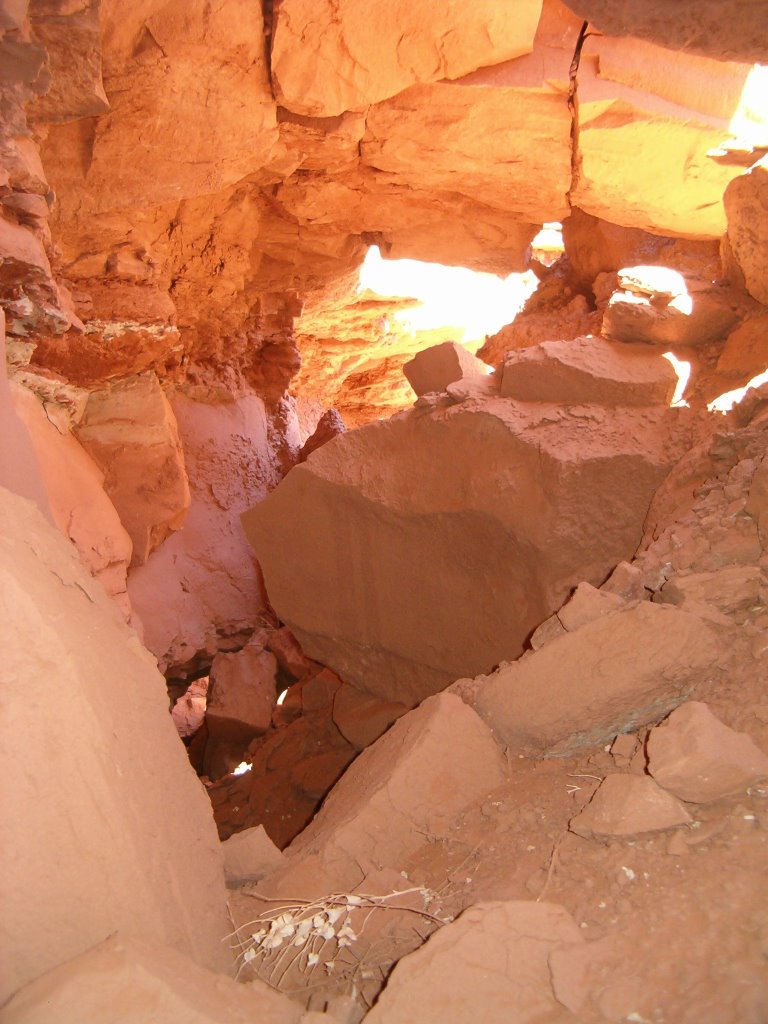
The consolation however came on day 4 when I started to find dinosaur footprints. In all, I found 9 sites with dinosaur prints or trackways; most of them at the edge of the cliff. Furthermore, I also got to do some spelunking, as I found several caves that had entrances large enough for me to crawl through. When I say crawl, I seriously mean it. Those of you who went to Tumbler ridge last summer might remember that I was squeemish about crawling through the smaller exit of the cave that we visited there. Therefore, in light of my claustrophobia, it should surpise you that I was able to do any caving at all. Below, you will find some of the photos of that experience, plus an obligatory ass shot.
While at this site I also saw a bit more wild life than I'd previously encountered, including a golden eagle, a porquepine, chipmunks, rabbits, various passerine birds, and heard (though I never saw) distant coyotes.


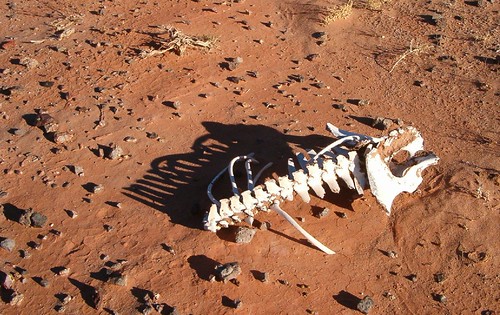
After finding nothing but caves and ichnofossils for a week, I moved camp and started exploring a valley that was a bit further to the Northeast. There I had a bit more luck. I found a number of micro sites containing weathered bone and teeth. 11 sites contained whole or partial teeth and I collected a large number of broken bone material that I intend to piece together like a puzzle some time in the future. I was also able to collect two nearly complete cow skeletons that had been bleached in the desert sun. I didn't find any bullet, but I'm sure that these animals didn't die naturally. They were only a few feet apart and showed no broken bones or signs of having died in any kind of a flooding event.
The plan is to get my tire fixed, re-supply and check out one last sight near here. I've been saving it for last since it is likely the hardest to get to and there is no way I'm going to venture over over (and off) roads that the USGS recommends 4 wheel drive for (incidentally, the van only has rear wheel drive, but that won't stop me) without a spare tire.

Thursday, March 23, 2006

Fire and Ice

After 3 weeks stuck in Flagstaff, Az due to weather, I'm finally heading back out into the field. I was very fortunate that I left the desert when I did, otherwise I would have been stuck with a 5 mile hike to the nearest town (not that far unless you're hiking through snow on uneven terrain) for supplies. During the last three weeks, I've remained optomistic that the weather would change and that the snow would melt. For three weeks, it didn't. In fact, it just kept snowing. This is definately not how I pictured Arizona in March.
After being confined here as long as I have, I started to consider my options. I could go west back to California and stay at my parents' place until the snow here melted or I could continue east until I was out of the snow. The latter option would take me as far as Texas. The Texas panhandle however has been on fire. Close to one million acres have been burned by wild fires, resulting in the deaths of over 11 thousand horses and cattle, as well as two people. Given my luck, I would have gone out to a site and been just out of range of either cell phone or radio reception when wild fire would sweep through the area. Besides, ash is worse for finding fossils than snow. It drifts, but it doesn't melt. Further east then, into the main body of Texas? No. Just as I was deciding how far east to go, the weather changed dramatically and the snow melted. Three inches of snow fell on tuesday. Today it's nearly all gone. Some might see the hand of providence in all this; quietly suggesting when I should leave an area, or when I should stay. No, it's just nature tending toward maximum irony.

Tuesday, March 21, 2006

More Book Reviews

As I said in the previous post of book reviews, the one nice thing about being stuck in Flagstaff is that I've gotten alot of reading done. And so, here are the reviews of the four books, in order, that I've just finished reading. I admit, I wish that I had read them in a different order.

Aristotle Indeed
One of my favorite authors is Will Cuppy. There's a good chance that unless you've heard me talk about him, you've never heard of him before. I don't blame you, nobody's perfect. Cuppy mostly wrote humorous but well researched articles about various extinct and extant animals. One recurring subject however was Aristotle. Cuppy loved to lambast Aristotle for his various follies in describing the natural world. For instance, Cuppy reports that aristotle believed the chambered nautilus to float at the surface of the water, using its shell like a boat and its two broadest appendages as sails.
It was with this critical frame of mind that I sat down to read Aristotle's Historia Animalia. I even had a pad of paper to write down every error as I read it, so that I could write a very long post about how silly and quaint the philosopher was. It was perhaps the only time in my life that I've been disappointed by someone being smarter and more reasonable that I thought that he or she would be.
Most of Aristotle's errors arose from a problem with homology vs. analogy. For examle, he states that the knee's of all blooded terrestrial animals that have hair or feathers (witht he exception of humans and apes) point backwards. In our modern perspective, we know that it isn't the knee that points backwards, but the ankle in all tetrapods that does so. The confusion arises from the fact that most animals adapted to a cursorial lifestyle have a short femur and a long set of foot bones that are held off the ground, giving the appearance of having a knee that points backwards. If you ask any child which way the knee of an ostrich or a horse bends, it would probably reply "backwards."
Another thing that I thought must be a gigantic error was the claim that "women produce semen." However, when you look at it from an ancient point of view, this is actually much closer to the truth than it sounds. Biblical scholars believed that a woman was essentially like the soil that a man's seed was planted in; that if you looked inside of a sperm cell, you'd see a little person and that if it was a male little person, he would also have proportionately sized sperm which contained even smaller descendants. Aristotle however believed that both a woman and a man had to contribute some form of semen from which the egg/ fetus was formed. From disections, Aristotle saw that the ovaries were connected to the uterus, and it to the other parts of the anatomy in the same way that the testes were attached to a common tube which connected to excretory organs. In animals with a cloaca, this was clearest, and there were greater degrees of seperation of the excretory and reproductive systems as animals became more advanced. All things considered, this is a very advanced way of looking at things.
Other errors that Aristotle committed arose from base assumptions on which he grounded his assumptions: that the right side of the body was interently better than the left, that the closer a bit of the anatomy was to heaven the more spiritually important it was (eg, most animals hold their heads in line with or only slightly above the horizontal line of the body but only people and birds, both of which capable of creating music, hold the head above the body. Only people have their heads directly above the body.), that you could tell a someone's personality from their facial fetures, and that information reported by his collegues was correct more often than not. This last assumption led to the belief that somewhere in africa there was a racy of tiny people who rode tiny horses and raised tiny cattle, rarher like Lilliput.
All together, I have to admit that perhaps Will Cuppy was more of an eisegete than I would normally like to admit of someone that I like.

Alice's Adventures inWonderland and Through the Looking Glass
Lewis Carroll, aka Charles Lutwidge Dodgson, was a genius. If you wonder about the alternate name, it's because the second is his given name, under which he published works on mathematics. People who have a natural flare for both mathematics and the arts (see also M.C. Escher & Bento) are no doubt all at least a little strange. Carroll certainly pushed the limits. Every chapter in his Alice books is positively abserd; filled with poetry, word games and character that take everything too literally. Unlike most victorian literature that has a young protagonist, Alice learns absolutely nothing of any practical use from her adventures and is by far the most reasonable person right from the start. After reading these two books, I'm sure that Carroll must be either the father of modern british humor, or at least the crazy uncle.

Harry Potter and the Complete Lack of Surprise
Rowling's books keep getting longer and longer, but the same amount of material seems to be covered in each. After reading Harry Potter and the Half Blood Prince, I didn't feel that much more had happened than in The Chamber of Secrets. The primary difference was amount of space devoted to character developement. Getting just about everybody in the book to fall in love with each other at some point or another takes up alot of pages. Not only that, but a tremendous amout of time was spent with Harry and his friends not really solving anything. Given that it was leaked that Dumbledore dies at the end of the book, possibly before the book was even released, it made it difficult for me to appreciate the ending when it happened. Even so, from the second chapter it was kind of obvious. Rowling's books follow a pattern: Harry and his friends enjoy a year at Hogwarts, wherein they solve a mystery, grow up a little, fight Voldemort or his forces and a good guy dies. The person that dies in each book is more important each time than the person who died at the end of the previous book. We all know that Harry can't die (at least until the very end) and it's hard to find someone more important to Harry than Syrius Black without going strait to Dumbledore.
My prediction is that book 7 will not be the ninal volume unless it is exceptionally thick (six inches wide at least). Rowling is richer than the queen of England; why kill the goose that's laying so many golden eggs? Of course, if the series doesn't end by book eight or nine, the readers might get a bit upset.

Chuck Palahniuk's Diary
High art is what an artist calls the attempt of another artist at a profound statement about art. Oscar Wilde did this with A Picture of Dorian Grey, Richard Russo tried this with Straight Man, Tim Burton's attempt was Edward Scissor Hands, and Chuck Palahniuk's claim to high (literary) art is Diary. This novel is almost exactly like every other Chuck Palahniuk novel; all the motifs are there:
1. Being abandoned
2. You always hurt the one's you love
3. The only way to acheive greatness is through suffering - "Self improvement is masterbation" (Fight Club). Another, almost identical motif is that the only way to be saved, is to be destroyed.
4. By the end of the book, the protagonist is toxified, emaciated and trying very hard to save society from themself.
5. The service industry sucks the life/soul out of you, and almost everyone these days is in the service industry.
6. All the characters are well educated and never hesitate to spout esoteric knowledge gained from what they ultimately felt was a wasted education.
7. Prominant architecture is destroyed at the end. This only happens in about half of Palahniuk's works, like the film version of Fight Club, but not the novel.
8. Once again, Palahniuk's disjointed, first person sentence structure has screwed with my internal monologue.
What differentiates Diary as Palahniuk's claim to high art is that the protagonist is a a failed art student instead of a failed something else. This gives the author the avenue to wax bitterly poetic about art history; the diseases of great painters, the pretense of visiual irony among modern artists -"Just smelling super gross doesn't make their work art." Furthermore, Palahniuk writes that "Nothing you ever create is original becuase everything you do is a self portrait. Shows some part of yourself." Given that, Chuck must be one really messed up guy, I mean seriously mentally fucked up. Every book is how he sees himself, his life, or at least that's what he's trying to say. The poor tortured artist.
What Diary lacks, that all the other books possess, is (and this really spoils it for you) a good surprise ending. Unlike all other books that I've read by this author, this book ends exactly the way you think it will. By the time that you're half way through the book, a cynical reader has figured out the conspiracy and all that remains are a few twists at the end that really don't change how you perceive the whole situation. There's no "because we're the same person," no "I shot myself," no "she's a mental patient too." No, it's just stuff like "turns out he was gay, who knew?" and "by the way, I was in on it the whole time." This isn't to say that the ending isn't twisted, it is. It's just that an intelligent reader sees the ending coming a mile away, by about the middle of the book.

Thursday, March 16, 2006

Belated Book Reviews

As a hermit, one gets to do a good deal of reading, and in the name of fairness I'll give you all my latest book reviews in one dose rather than torture you with them over a long period of time. In fact, you don't even have to scroll past them if you don't want to. However, if you care to, simply follow the link to the full post.

Good Omens = good read
If you liked the movie Dogma and you like the writing of Douglas Adams, then there's an excellent chance that you'll enjoy Good Omens. The premise is as follows: A satanic order of talkitive nuns accidentally misplaces the antichrist, who incidentally turns out to be a really nice kid. Meanwhile, the minions of heaven and hell amass for the final battle at armaggeddon, the four bikers of the apocolypse (war, famine, death and pollution; plague retired in the 30's mumbling something about mold) converge on a small idealic village in Brittain and an angel and demon who were both proven incompetant a few days after the creation bend their awesome power and subhuman free will towards preventing the end of the world. Owing the the multiple plains of existance on which the story takes place, there are alot of characters, but it all comes together like the end of a Guy Ritchie movie. And all of this, as the book explains, was fortold in "the nice an acurate prophecies of Anges Nutter: witche" which, while indeed acurate, was the most unsuccessful book of prophecy ever published.
Furthermore, I'd like to thank Mr. Tyler Shaw for recommending the book. If he doesn't read this blog, more's the pitty.

Treasure Island:
This is one of those books that is so famous that everybody knows the story; so well in fact, that not many people that i've spoken to have actually read it. R.L. Stevenson definately wrote this book for kids, there is no doubt about it. It is fast paced, the plot is simple enough and all of the characters are rather flat. Many have hailed treasure island as a 'growing up' story, wherein Jim Hawkins (who's own father dies early in the book) learns a great deal from Long John Silver and their voyages at sea. This idea has so well permiated thought about the book that adaptations are forced write that stuff in. Disney's Treasure Planet is the worst offender in that department; though given all the other liberties that they took with the story, it can certainly be understood.
Despite these seeming literary short comings, Treasure Island is is very enjoyable in much the same way as The Coral Island is more enjoyable than Robinson Crusoe and episodes 4, 5 & 6 of Star Wars are more enjoyable than episodes 1, 2 & 3.

Robinson Crusoe:
This was the origin of the ship-wreck genre, the architype that all the others copied, transcribing all that is good and bad about it. In terms of the good, Robinson Crusoe had far more believability than any of the other ship-wreck novels that I've read. Unlike the Swiss Family Robinson, the protagonist doesn't know the names of every creature that he meets and isn't confronted by, and have the opportinity to eat every creature in creation. Furthermore, unlike The Coral Island, Crusoe recognizes that discression is the better part of valor and only confronts savage cannibles twice - and with guns not sticks. Even the Cannibles are more reasonable: only eating prisoners of war, not killing and eating each other on a whim. Once again however, the drawback for me was the overdone praise of god. I'd estimate that a full one third to one half of the book was devoted to various forms of worship. Crusoe considers himself a rather sinful person and a bad Christian, but never-the-less spends page after page reflecting about how he should be more thankful for his deliverance from danger and sin. The christian prostelatizing in The Coral Island was overwhelming because of the bias and biogtry of the christian viewpoint. In Robinson Crusoe, it's overwhelming because he just talks about it too much.

Life: The Odd (And How to Improve Them):
A decently humorous look at the odds of events happining to random people. E.g.: Dating a super model, marrying money, having the same birthday as someone you meet, death by various means (including desctruction of the earth and of the universe), winning the lotto, etc. It makes a good reference book for some of the esoteric knowledge that one might, eventualy, actually be interested in calling on.

The Ig-nobel Prize:
A very funny book that comes from the annals of improbable research, in the same vein as the Darwin Awards. Not all awards are ignoble as improbable. A prize for chemistry was given to the woman who figured out how to make Jell-o blue. Others are odd but not quite dubious. A prize was given for the publication of a six-page standard opporating procedure for making hot tea. Other awards are as dubious as the name suggests. Various awards were givin to people for writing about the face on Mars, quantum healing, microbes that kind of look like people and dragons (thereby showing that our ancestors were tiny), and the memory held by water of chemicals that it no longer contains. The people awarded this latter group of award did not show up at Harvard to collect their prizes. Like the Darwin Awards, it is a book that is meant to show just how abserd the world is, and to make the reader feel better for never having done anything that might qualify. However, unlike the darwin awards, people who don't win ignobel prizes are more likely to suffer from a dearth of imagination than an abundance of intelligence.

Wednesday, March 15, 2006

Planetary Mineralogy

There has been a great deal of coverage in the press lately about the discovery of a mineral that is characteristic of very high temperature environments, from a comet, which is typically described as a ball of ice. The mineral in question is a two micron grain of Forsterite, a magnesium rich form of olivine from ultramafic magmas. Unfortunately, I do not have the benefit of having taken any mineralogy courses. I have however been able to find out that Forsterite is stable below 1,557° C, which means that where ever this crystal formed, it had to be exceptionally hot. I however do not think that this necessarily means that it formed near the sun as many people are saying, but could have formed in situ within the asteroid belt. Olivine is found all the time within stoney meteorites. Those of you at the University of Alberta have an excellent opportunity to see this by going to the Mineralogy/ Petrology museum in the basement of the Earth Science Building.
Scientific pondering to follow:
Three things that I'd like to know are: 1. at what pressure does a magma need to be at to form forsterite? 2. what form of olivine is found in the chondrites? 3. What is the currently favored hypothesis for how loosely agregated masses in the asteroid belt become a single, solid mass that can then differentiate? Anyone who works for Dr. Herd at the U of A should feel free to answer these. If they don't read this blog, more's the pity.
Regarding the last question, I have my own idea: space lighning. Okay, it's perhaps not the best name for it, but if dust particles rub past each other, there's bound to be a build up of an electrical charge. When lightning discharges on earth, it reaches temperatures of up to 28,000 kelvin and frequently turns sand that it hits to glass structures called fulgurites. This certainly seems to meet the temperature requirements. If this happens on a reqular basis over a several billion year period, one might expect some fairly large masses to ultimately fuse together (collisions would regularly break up masses too, and after a certain point gravity and radiation would have the more dominant roles). The problem with my hypothesis however is observability. Electricity arcing through air is highly luminous, but in the vacuum of space it wouldn't give off much light in the arc, but rather as a diffuse cloud as it heated up the dust. Furthermore, lightning is small by comparison to objects that are easily seen with telescopes. Of course, if there's a problem with my reasoning due to my own ignorance, I'd appreciate it if someone corrected me.

Tuesday, March 14, 2006

Exchange Rates


In the past, with regard to the U.S. economy, I've done very little but complain about the decreasing value of the U.S. dollar compared to the Canadian. For once though, I'm glad that the U.S. dollar is failing. This isn't because I'm unpatriotic or unamerican. Quite the opposite, I'm a capitalist pig who wants to get the most that he can. As a consiquence of leaving much of my funds in a Canadian bank, my money is growing faster than if I had put it into stocks. Furthermore, I have the liquidity that one would expect from any bank account.

Monday, March 13, 2006

Suspicious

I get the feeling that there was an alterior motive to holding a paleontological conference in Maastricht.

Saturday, March 11, 2006

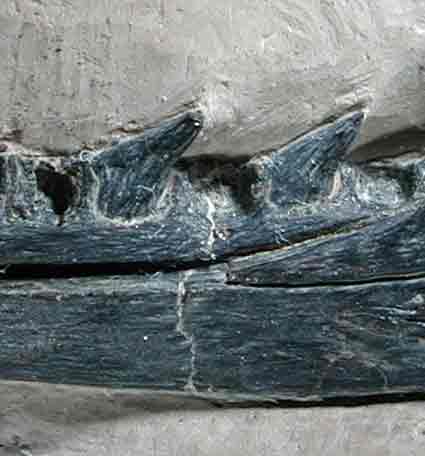
Palaeophis: a snake with thecodont dentition?

The specimen pictured at the left is of Palaeophis toliapicus from the London clay of the island of Sheppey, in Great Britain. The whole specimen is one that represents the only known complete skull of Paleophis. It is however owned by a private collector who has so far been unwilling to donate it to a public institution. As one can see, the dentitiion is rather unique for snakes, appearing to be thecodont (set in sockets) rather than pleurodont (adhered to the side of the jaw). This is particularly interesting because it bolsters the hypothesis of a mosasauroid (who also have thecodonty) origin of snakes, which is favored by Caldwell, Lee and Scanlon.
Since this is such a unique specimen and since the owner is simultaneously interested in having it studied and unwilling to part with it, I propose a compromise. If the owner were to donate the specimen to a public museum, it would receive an accession number and then could then be published on. The museum would subsiquently issue the fossil on a long term loan back to the collector so that he may keep it in his personal collection until deciding to have it stored in the museum or his eventual death. Either that, or someone should just find out how much money he wants for the damned thing and raise the funds to buy it from him. Of course, givin the fact that these collectors have found two articulate specimes in the last 10 years, it makes sence that someone aught to send out a field crew and try to find a specimen specifically for a museum.

Friday, March 10, 2006

There's a Lesson Here

"Everything's got a moral, if only you can find it." - Lewis Carroll

If anyone has wondered why I'm blogging so frequently this week when I should be in the field and distantly removed from civilization and computers, it's because I'm stuck here in Flagstaff. The reason is that its snowing here and it would be stupid to try to take an Astro van off road through the snow. Furthermore, it would show equally poor judgement to go out too soon after the snow melts because the hills that I'm interested in are made up largely of bentonite. When wet, bentonite becomes as slippery as grease. It's one thing to get one's car stuck in sand (done that), another thing to get it stuck in snow (done that too), but it's something entirely worse to get it stuck in bentonite.

My situation however smacks of irony. When I came into Flagstaff to re-supply I was sun-burnt from the waist up. In spite of the mild pain, I'd been enjoying the warmth and sunshine so thuroughly that I considered it a large, red badge of honor and was glad to have it. To this end, I mocked those of you in Alberta who were forced to trudge through close to a foot of snow. Now, after over a hundred days without percipitation in Flagstaff, I have to contend with snow, people that have no idea how to drive in snow and the fact that my only entertainment comes from my favorites on the net and going through the NAU library's entire natural history section.

Thursday, March 09, 2006

Paleo Poetry

What follows after the break is the remainder of the paleontologically inspired poetry that I came up with last night. I had been meaning to take notes on Aristotle's Historia Animalia but found my diversion much more rewarding.
Three attempts at verse:

Ode to an Elasmosaur

Among the many creatures

Who've lived in the briney deep
the plesiosaur is very special
for his neck is quite unique.

It's as long as it is slender
and supports a tiny head;
The head supports his many teeth
that fill fishes full of dread

The length of the neck is what's peculior,
as its not shared by seals, turtles or the whales.
What is this adaptation for?
It's so they can look at their own tails.

Plea From an Inverted Turtle

I am not dead.
I simply cannot right myself
as I am flipped upon my back.
I was put in this position by my rival
in a sudden sneak attack.
He did it because he got it in his head
that to be this way would be deleterious to my health
and thus my chances of survival.

The problem as I see it
arises from my shell
which keeps my feet a pointing skywards
and thus me from moving all that well.

And if you help me get right side up today
it's a courtesy I'd someday be willing to repay.

Reflections from a Mosasaur

"I am not a dinosaur,"
states a lizard gliding through the surf
"I have been much happier
For abandoning the turf.

A land lubber I am not
I much prefer the waves
going about upon the shore
is no way for a Clidastes to behave.

My yellow scales stay bright and clean
And my body long and lean
And if you wonder why I abhor the shore,
The reason's plainly seen.

I enjoy eating till I'm busting
Things a dinosaur finds disgusting
Since I could wish
For no greater dish
Than of calamary or some fish."

Wednesday, March 08, 2006

A Permian Parable

A Dimetrodon and an Edaphosaur
One day happened to have a chat
Wherein the Dimetrodon remarked
That they were both getting rather fat.

"The issue with my waistline
Has its roots within my head.
And if you come a little closer
I'll explain just what I mean."

For a moment the Edaphosaur hesitated,
his feeble brain gave him an inckling of dread,
but since they both had sails upon their backs
he figured that they must have temperments equally serene.

"Obesity is caused by caring for our dentition"
continued the Dimetrodon, who smiled as he said
"A little closer perhaps and you'll see
That I keep every single tooth of mine exceptionally clean."

Now, an Edaphosaur is quite stupid
And he is easy to mislead
So that while examining his companion's teeth
he became trapped in between.

Thus by eating other poor pelycosaurs
The Dimetrodon keeps himself well fed.
He gives the appearance of being docile,
but is not what he seems.

Monday, March 06, 2006

Science News

- Snake!
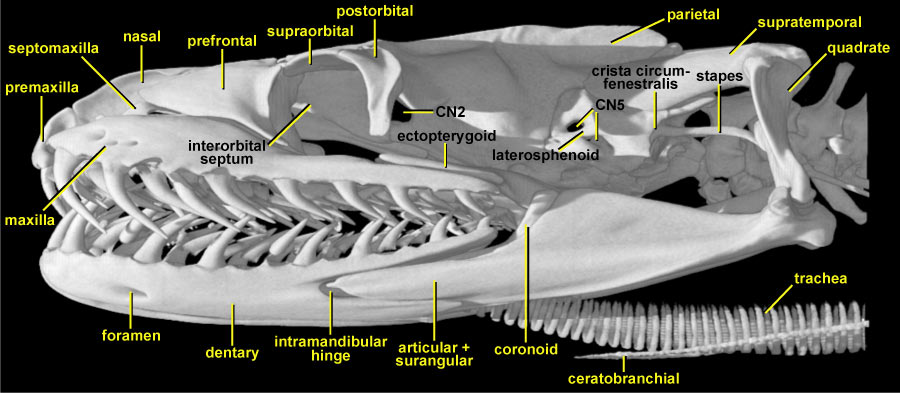
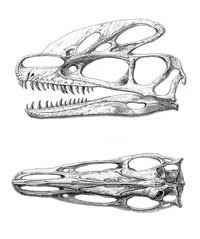
I evidently made a mistake by not applying to do research in Australia. They've aparently found another large, non-macrostomatan (what you typically think of when you think snake) snake. From the picture below a couple of really cool things pop out at me right away. First, the quadrate looks rather similar to the c-shaped condition of mosasaurs. The other thing is that the trigeminal foramen in the prootic of the braincase is open anteriorly and would have been bound on that side by the descending flange of the parietal. I'll grant that this second feature could just be an artifact of breakage, but if not, then it represents the primitive condition also seen in Wonambi. Another cool thing is the jugal. In varanids, the lower half of the orbital margin is made up of a robust jugal. It appears to be the same case here. In a python, there is no jugal. In the defense of people who say that mosasaurs are not the sister taxon to snakes however, this snake has big nasals and small premaxillae (the other way around in varanoids), the frontal-parietal suture is pointed backwards rather than being straight and I see no supratemporal listed in the diagram.

Yurlunggur:


Python


-Immunologists realize that lab
mice have two thymuses (thymice?), not one.
I honestly can't blame them too much for missing this little organ for the last two hundred or so years. It's about the size of the head of a pin and looks like a lymph gland. My only concern is that this might be an abaration of using lab mice rather than wild mice. Lab mice are all genetically identical. It's like there are 80 million clones. If however a mutation were to rise in one of the breeding stocks of lab mice (say, for an extra thymus), it wouldn't really get noticed and it might be coinsidence that this particular research team got mice from this mutated stock. In humans, the number of thymuses is incosistant, with most people having one in the chest and some having an additional one in the neck as with these mice. I'd like to see if a wild mouse has an extra thymus.

-Leave it to scientists to find a way to grow tits in the lab.
Naturally, the report only talked about the prospects of this research for treatment of breast cancer and not augmentation.

-Plants produce greenhouse gas
I was forced in high school to memorize the Kreb cycle, the Calvin cycle and several other cycles and pathways that I've since forgotten the name of. But aparently there is a new one that produces methane under normal atmospheric conditions. I can't wait for the conservatives to jump all over this and say that cutting down the rainforest will help eliminate this greenhouse gas.

-Further evidence that my Y-chomosome is mostly junk DNA
Any guy who has taken genetics or who has a girlfriend that has, has been told that only a very small part of the gender determining Y-chomosome actually does anything; specifically regulate the production of androgens and of hair on the earlobes. The rest of the chromosome is there so that it can line up with the X during myocis. To do this, there has to be some similarity to the X, otherwise the two wouldn't come together. Aparently though, this hasn't stopped repeated, massive mutations in the Y-chromosome that further show that you can do a whole lot to it (except have more than one) without deleterious effects.

-Hummingbirds capable of watching scientists
A study conducted on rufus troated hummingbirds provides evidence that the birds are able to remember now only what something looks like and where it is, but when they last saw it. This was done by refilling artificial flowers with nectar at specific intervals. The hummingbirds made a pattern of visiting the flowers right after they were filled. So either they can remember things well, or can deduce that everytime a person goes to a fake flower, it gets refilled.

I (and a few other Albertan Paleontologists) owe Nick Longrich an apology.
Nick didn't make the cover of Scince magazine, nor did he contribute to the article that it relates to. He did however give a talk on the exact same kind of convergence on the semi-aquatic lifestyle in a mesozoic non-eutherian mammal last September at a conference at the Royal Tyrrell Museum. Nick is known among his friends (and we really do consider ourselves friends of his) for being able to talk your ear off for extended periods of time and for drawing dramatic conclusions from only a little evidence. In September he tried to convinse us that didelphadon was semi-aquatic and had a beaver-style, flattened tail. I and a few others were skepticle because he only had two, relatively unrelated pieces of evidence. First was his recognition of some flattened mammalian tail vertebrae, the second was a well known set of robust jaws. The two have never been found together. But this new chinese discovery makes it look like Nick might have been right after all.

Saturday, March 04, 2006

Photographic update

It's amazing how quickly one can go through more than 256 megs of memory when taking pictures.
Here are a few for the people who don't check the "my photos" link in the sidebar.

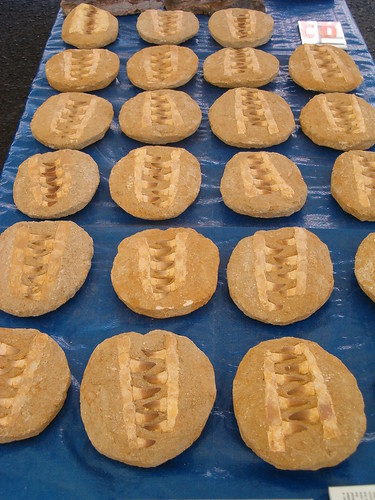
These Moroccan mosasaur jaws which for sale by the hundreds in Tucson are all fakes. The teeth are genuine Prognathodon teeth, but they aren't really set in jaws. They are composites composed of teeth and ribs set in a matrix of sand and adhesive.


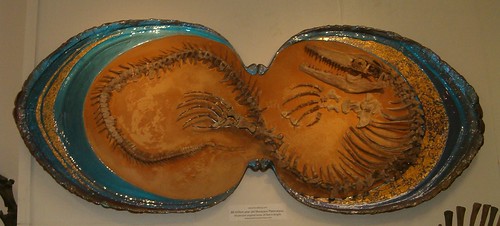
Some people at the Tucson show got a little creative with their fossils; mixing paleontology and art.


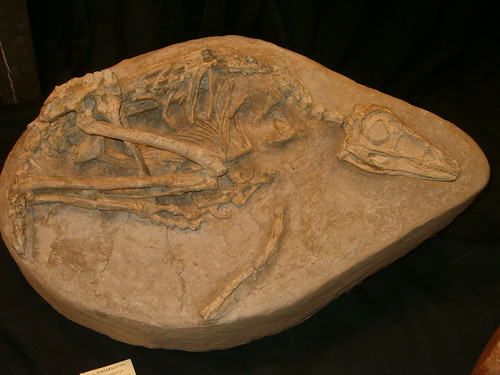
There was some very cool stuff for sale there. This is a mongolian theropod. I don't know what kind, but its probably a troodontid. With the exception of missing a little bit of it's tail, it's a perfect specimen.


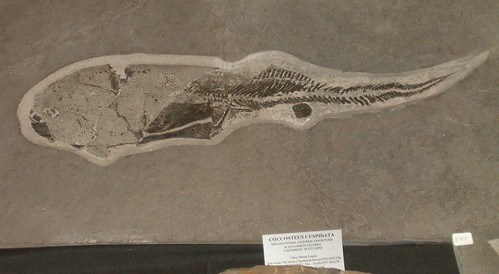
of course, there were fish too.


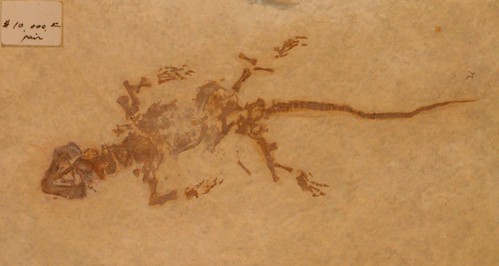
for those of you who are fans of the lizards, this one is from the green river and cost only one quarter as much as the above dinosaur.


an unintentional goatse near the one of the host hotels in Tucson


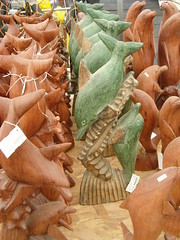
this one is from the Quartzite show. They're supposed to be dolfins, but givin that they are green and have a virtical rather than horizonal tail fluke, they must be ichthyosaurs.


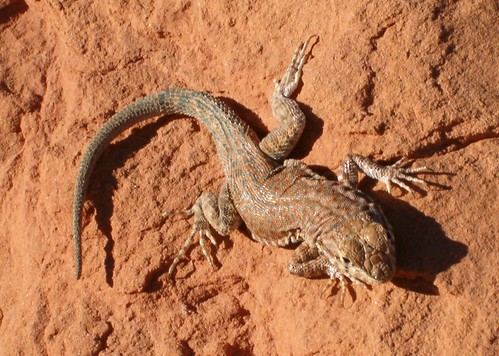
more recently, I've been able to take some excellent macro photos of the abundant lizards in the painted desert east of Cameron, AZ.


unfortunately, the climate in the painted desert is extremely dry. Consiquentially, there is no wood for me to make a fire with, which has lead me to purchase a propane camp stove now that I'm in civilization again.

For the future, there will typically be a one month lag between when I take a picture and when it ends up on-line since I max out my free flickr account very quickly and am anxious to get as many photos online so as to clear up memory on my USB key.

Friday, March 03, 2006

Survey

1. If you had to choose between being blind, deaf or never being able to walk again, which would you choose?
I'd choose to be deaf. I've never seen a scientific journal in brail, it's difficult to study microscopic anatomical features by touch and I've only ever heard of one guy doing field work who couldn't walk.

2. If you could have any suite of super powers (those existing in combination in an established character: eg. Wolverine has claws and healing, Superman has strength, speed, x-ray vision, etc.) which would you choose?
Jedi powers: telepathy + telekinesis + light saber. I'd so abuse them.

3. One physical feature that you don't like about yourself and can't easily change.
I have stubby fingers. It is perhaps why I'm not a professional jazz saxophonist.

4. One physical feature that you like about yourself and isn't likely to change.
my blue-grey eyes

5. Three physical features that you look for in the opposite sex (amend this question for your own preferences)
a. elegant neck
b. slim (preferably weighs the same as or less than me)
c. brunette or red head

6. Three personality traits saught in the opposite sex.
a. intellectual/ nerdy : must be well read
b. cynical/ sarcastic : not necessarily the same but usually go together
c. extrovert in some way. When two hermits get together, they soon seperate.

7. If you could not have your ideal profession (paleontologist in my case) then what is your plan B?
Get my graduate gemologist degree (one semester) and appraise gemstones, especially diamonds, for a living.

8. Which do you relate to more, Calvin or Hobbes?
Hobbes, because he views humanity as inately flawed and is much more sensible and reasonable than Calvin. Furthermore, others go to him for academic help (though his answers are as much smart sounding BS as truth). Also, he is fulling willing if not eager to go exploring. I do however get along with Calvin types, which I suppose is reasonable to expect.

9. How many states, provinces and countries have you been to?
States: 18; AK, AZ, CA, CO, NV, FL, HI, ID, MD, MN, MT, ND, NY, SD, UT, VA, WA, WY
Provinces: 3; BC, AB, MB
Countries: 3; USA, Mexico, Canada

10. Three things that you'd like to do before dieing.
a. write a best seller
b. be the owner and opperator of my own museum
c. anything that makes it so that school children will be forced to learn about me; famous or infamous.

11. Favorite personal possessions.
a. my entire fossil collection - I don't divide that kind of thing up
b. my fedora
Sunday, February 19, 2006

In the Field: week 1

I spent the last week in the painted desert, particularly the Chilne and Kayenta formations, of Arizona, about 50 miles north of Flagstaff. It's awesome! The whole of the Chilne formation in this area seems to be a petrified forest. There are large trees in situ and fragments of petrified wood everwhere. It did however take me a few days to find any bone material and it's rather difficult for me to tell where the boundary between the Chilne and the Kayenta formations actually occurs, so I'm not always sure if I'm in the upper Triassic or lower Jurassic. Two of the days without finding bone don't entirely count. On one day I was asaulted by a sand storm that kept me pent up in my van most of the day1 and on another I spent without success while trying to find a known bonebed in the Kayenta formation2. The last couple of days however have been a great success, wherein I've found one in situ partial skeleton that I've begun excavating and one microvertebrate site from which I've recovered over 20 vertebrae, several partial ribs and four teeth as well as several whole and countless fragmentary osteoderms3. I can't be sure, but I think that most of the material that I've found belonged to a group of large plant eating reptiles called Aetosaurs. However, it is just as possible that the osteoderms that I'm finding belong to one of the other archosaurs that were alive at the time.
My most significant discovery so far however is of a piece of petrified wood from a tree sized lycopod, which I think might be stigmaria or a very worn down lepidodentron. I didn't bring my paleobotony notes with me, so it's difficult to say. The reason that this is significant is that this group of plants is thought to have died out completely by the middle permian. The fact that I found this in either late Triassic or early Jurassic rocks means that the group lasted more than 60 million years longer than previously thought and in fact survived a mass extinction that killed off more than 90% of all life on earth at the end of the Permian!

1. Two things learned that day were: A. never try to brush your teeth during a sand storm. B. Aviator sunglasses are not an adequate substitute for safety goggles when going for a walk in a sand storm.

2. The site was 10 km east of my camp site and consiquentially meant that by the time I got there I only had an hour of prospecting before I had to turn around and go back. I still didn't get back until after dark. While descending a hill in the dark I fell and hurt my right knee; something that's slowed me down every day since. Bad show all around.

3. If you don't know what an osteoderm is, think of the armor plates on the back of an alligator or crocodile. They're modified scales with a bony center. Unfortunately, just about everybody in the triassic had them, making them unhelpful for identification purposes.

Thursday, February 09, 2006

Tucson, Day 7

I saw the last of the show today and was kind of disappointed that the remainder was almost entirely minerals. It's nice and shiny, but it doesn't pique my interest. As with the fossil dealers, alot of the minerals were the same kind of specimens, the same quality and from the same mines, just in the booths of different dealers.
I'm skipping town tomorrow, right after a trip to the post office to send all the stuff I've picked up to my parents for storage. Sorry Mom, sorry Dad, but the museum has to be put somewhere. There is still a chance for me to pick thinks up for people who are interested so long as you call me before 2:00pm mountain time.

Wednesday, February 08, 2006

Paleo-News

A new primitive Tyrranosauroid has been described. This time it has a crest on it's head reminiscent of a pterosaur. They're calling it Guanlong wucaii. As with other crested theropods, the standing hypothesis is that the crest was used for sexual display. Furthermore, following recent trends in popular analysies to do on specimens, a histological thin section was made of the (presumably) fibula and was used to determine that this animal was in its 12th year of life, while another specimen found associated with it was only 1/2 as old. Unfortunately, this discover, as well as others, came too late to make it into the most recent edition of the Dinosauria and will likely not be added as an adendum to The Relationships of Basal Theropod Dinosaurs.

Advertisement

Guy's, Valentine's day is coming up and if you want to get your special lady some fine jewlery, I'm the one to talk to. If you send me a request, I'll find it here in Tucson for considerably less than you'd see at a boutique. I recommend pearls. To get ahold of me for requests, call my cell at (714) 767-2886. I'll send you a picture of the item, a price, and if you like it I'll ship asap.

Tucson, Day 6

Didn't do a whole lot today; contradicted what I said yesterday about not buying anymore moroccan fossils. I just couldn't resist. I bought one jaw segment that looked like it might be from Globidens (it wasn't) and two small blocks that I realized fit together, giving me two nearly complete dentaries; $10 per block, so $30 total. Yesterday I saw two cleaned dentaries of about the same size for sale for $175 and $225 each. It's definately worth my time to prep out the specimens myself. I'm still trying to figure out if the bone fragment associated witht the pterygoid that I cleaned up the other day is an epipterygoid or something else.
Other purchases: 1 dried Draco (the kind that glides using an expanded rib cage) lizard $40, 1 skink skeleton $25, 1 book on the ammonites and other cephalopods of the Pierre Shale formation $20. The guy who was selling the modern lizard material said that he could also hook me up with indonesian monitor lizard skulls, possibly a whole skeleton, and various snake skeletons on the cheap.
In other news, I dropped by the various gem expos around town. I was like one of pavlov's puppies hearing the bell. I saw gems so gorgeous that I wouldn't dare desbribe some of them, lest I do them injustice. One that I will describe though is an emerald that measured roughly an inch and half by 3/4 of an inch. It was a brilliant stone, moderately clear, but of a pale green. It had to be over 150 carats. It almost makes me want to take a semester of gemology to become a master appraiser.

Tuesday, February 07, 2006

Tucson, Day 5

For me and for now, the buying of fossils has ceased. I decided against buying a badly crushed Moroccan Prognathodon rostrom even though I talked the dealer down to nearly half of his original asking price. Most people decide not to buy something that they want because of a bad experience with people selling it or because they can't afford it, I decided not to buy it just because of the good experience I had with another set of dealers of Moroccan fossils. Until now, it'd been my experience that these dealers are shifty and fake as much of the vertebrate material as they find and that they were ignorant to nearly every aspect beyond the name and price of the specimens that they sell. I'll admit, I even got a little racist; generalizing all dealers from Morocco as generally hurtful to the scientific process. The people with Sahara Overland however are quite different. One frenchman with the company was quite knowledgeable and even knew Dr. Caldwell, read his papers, as well as just about all other literature on vertebrate paleontology in north Africa. In fact, I listened to a rather passionate tirade about how North American scientists are throwing away research opportunities buy not working with them.
The other people were also helpful; one Texan even flat out told me that I shouldn't buy any of his "complete" skulls, calling them "Ribosaurs." As a consiquence, Sahara Overland and it's sister company Doc Fossils, are the only Moroccans that I have or will do business with. When I bought the trilobites in Quartzite, it was from Sahara Overland. Yesterday I bought a section of Halisaurus (a mosasaur; I'm guessing on the genus based on its small size and strongly recurved teeth) pterygoid and a parietal and partial frontal from a (I think) Prognathodon. Tomorrow I'll buy an isopod from them which I'll send up to a friend in Canada who is studying them currently.
As a consiquence of my good experience, I have decided that my next great adventure will be to Morocco. Naturally, this trip may have to wait until after grad school, but I will not buy any large specimen until I've been to Morocco and had the chance to satiate my facination with fossil reptiles. Until then, the US is my hunting ground.
On another note, I've had some success in interviewing people about the rock and mineral trade. The consensus so far, among rock, mineral and fossil dealers alike, is that paleontologists have their heads up their collective ass with regards to policy for collecting on public lands.

Sunday, February 05, 2006

Tucson, Day 3

Today was a good day. Althought I spent alot of money, I feel that I got some awesome specimens as well as some good information on where to find more. In particular, I bought 3 lizard jaws, two turtle jaws, a small turtle skull, three or four large salamander vertebrae, and about 40 snake vertebrae - all from the late pleistocene of Florida. I also bought 4 Branchiosaur larvae for $100. I also picked up a tiny Keichousaur and a section of pleistocene alligator maxilla that shows replacement teeth growing in under the older teeth. Most of all though, I'm happy to finally have found some affordable lizard material. I'll grant that it isnt' that old and doesn't say anything about the origin of snakes, but it is a start to figuring out changes in squamate biogeography in North America during the latest cenozoic.
Tomarrow I anticipate spending more. One of the most unusual things I found today was a collection of Miocene partial penguin skulls. Given how odd these are, I'm compelled to spend a little money on one. I also found a Moroccan mosasaur brain case and another fragmentary skull for a good price. On the other hand, I've been hearing some very compelling arguments for me to ignore the dealers here and just go to Morocco myself. That however is a trip that will have to wait.

Saturday, February 04, 2006

Tucson, Day 2

Today, I found more of what I was looking for; specifically interesting fossil lizards. Not only that, but they are cheaper today ranging from only $1,800 to $10,000 for whole lizards and $300 for a mosasaur braincase. The most interesting things of today were a partial Agialosaur (close relative of mosasaurs) and a small, possibly jouvenile Archialosaur (also closely related to mosasaurs) from Brazil. If I hadn't used up all of my Flickr uploads for the month of February, there would be some pictures here to illustrate what I'm talking about. In the mean time though, I'm going to e-mail some pictures to Dr. Caldwell to see what he thinks of them.

Friday, February 03, 2006

Tucson, Az

The word of the day is disappointment. I had envissioned the Rock, Mineral and Fossil show at Tucson to be some sort of magical land where dealers coffer their earthen wares at prices close to what you would pay in the region that these fossils are from; a place where I could find fantastic deals and specimens worthy of study. This was not the case.
I'll grant that there are some spectacular items here. Among these are ichthyosaurs, Psytacosaurs, Eocene bats and birds and more ammonites and trilobites than you can shake a stick at. The fact of the matter is however that everybody knows what their fossils are worth and are selling them as such. We're not talking cost of replacement, but ebay, open market price. Before I came out here I looked at people's photos from previous years. Since everything has a price tag on it, it was easy for me to guage how much I would expect to spend. It seems that the price of two of the things that I was interested in buying has close to dectupled (10 fold increase) in the last couple of years. Where photos from previous years showed Sinohydrosaurs and Keichiosaurs for below $50, with some as low as $25, the price now starts at $150 and goes up to $400 for small ones. Incidently, very small and very large specimens are worth more; as though most of these creatures consistantly died at the same age.
The thing that I've been looking all day for is lizard material. Alas, I only found one non mosasaurian lizard. It was from the Liaonang formation of China (same as sinohydrosaurus). I got a picture but didn't have time to reference anything to find out what it was. The cool thing was that it had skin impressions showing scute like scales on the tail. The only drawback was that they guy was asking $28,000.00 for it. He was only asking $25k for his complete theropods (excluding birds which were less) and about 25 hundred for psitacosaurs.
On the positive side, I did manage to get two of the largest Paleophis vertebra I've seen for free. The guy was selling mixed fossils from morocco by the pound, and the vertebrae were too light for his scale. Consiquently, he just gave them to me. Another gem of a find was a miocene snake vertebra from Florida.
I just hope that tomorrow is more rewarding.

Thursday, February 02, 2006

New Phone Number

If people want to get ahold of me by phone, my new number is (714) 767-2886.
I changed so I wouldn't get charged roaming or for night or weekend calls. Night is from 7 pm to 7 am. Not only that, but my parents are paying for it since it only costs them $10 per month to add me to their plan.

Wednesday, February 01, 2006

Neo Con Mom

My parents keep getting more and more conservative. They've bought in completely to the "freedom in exchange for security" mentality. It's a major difference in paradigms; so much so that nothing I ever say would be able to convince them otherwise. We just have different views of what is important. I opened with comments about the Boing boing article about it costing 15 million dollars per person caught with the US - visitor program, and they rebutted with "it's worth it, because it's a deterrant. Besides, the cost per person caught will decrease as more people are caught."
Last night, the president announced a "22-percent increase in clean-energy research. . . to invest more in zero-emission coal-fired plants, revolutionary solar and wind technologies, and clean, safe nuclear energy. (Applause.)1 " I checked the department of energy website but couldn't find how much is currently being spent on these kinds of programs. I think that somebody should do a study on the cost effectiveness on reducing the probability of terror attacks, comparing spending on programs that increase security and those that reduce dependancy on middle eastern oil. I'll grant that such a study would probably cost $15 million, but that just means that we wont catch Cat Stevens the next time he tries to enter the USA.

1. That quotation is from the white house website. The "applause" was actually written into the transcript. I'm not sure if that means that people were scheduled to applause there, or actually cheered spontaneously there.

Thursday, January 26, 2006

Wakey wakey, now assume the position.

This morning I was awoken at 5 am by six LA county Sheriff's deputies. The reason for this is that I was sleeping in my parents' rental house, which is (with the exception of some of my stuff) currently vacent so that some remodeling can be done before my parents move in. My next door neighbor saw my van, assumed that I was a squatter and called the cops. The real irony is that even when I was a squatter in an otherwise abandoned house, nobody called the cops.
I calmly explained to the officers that I was visiting from out of town an actually belonged there. When they examined my drivers lisence, one officer asked "visiting all the way from fullerton?" It was fortunate that still had my U of A student ID in my wallet and that my parents gave me keys rather than make me use the unlocked back door like everybody else (including all six deputies). They officers checked my record and left after concluding that I didn't have any outstanding warrents that they could arrest me for.
A few of things pissed me off while they were there though. First of all, one female officer unholstered her gun and used her free time to check out the laser sight on it. They didn't seem very amused by my reference to Pen and Teller's comedy rutine about hand guns with laser sights. The important thing however is that the gun should not have been unholstered while I was on the floor with my hands behind my back. She wasn't even pointing it at me, she was just sort of aiming down the hall. Another thing that pissed me off was that it took six officers to do this. That means that they called in backup before they even got to the house. Sure, they're covering their asses, but a few could have left once I was subdued (and by subdued, I mean woken up and placed on the floor). The last thing that piqued my annoyance was that one of first things that one officer said was "we're just checking out a complaint, we're not stepping on any of your rights." My little internal monologue responded "like hell you are" but I didn't think that it'd really help my situation to say it outloud. What has our society come to when officers say "we're not stepping on your rights" rather than actually telling me what my rights are.
It didn't occur to me until right after they left to ask what legal code allowed them to enter a home without permission from the owner or a warrent. Right before writing this entry, I called up the LA County sheriff's office, got the run around for 5 minutes and then was told that forced entry is at the discression of the dispatcher depending on the situation. I wonder what they would have done if I wasn't sleeping there, if I had just parked the van overnight. Would they have towed my vehicle from a private driveway without permission of the property owner? Ah yes, it's good to be back in the land of the free secure.

Monday, January 23, 2006

When did I become uncle Rico?

Similarities noticed between myself and the antagonist to Napoleon Dynomite:
1. When I'm not crashing with my relatives, I live in a van that's more than a decade old.
2. I currently have a rediculous looking, thin mustache.
3. I fixate on the past; not my past, but the past none the less. I also wish I had a time machine.
4. I sell things door to door; I sell fossils to people I know are dealers rather than crockery to neighbors, but it's still sales.
5. I have already heard one sibling say "Gaaa, quit eating all our food!"
In short, I'm one football and one camcorder away from being uncle Rico.

Also, for future reference, I'm going to be milking the fact that I now live out of my van for every pun, joke and reference I can get. You've been warned.

Thursday, January 19, 2006

Fullerton, CA

It'll be interesting to see what a map of my path looks like when I'm done with my travels. I'm now at my parents' place in Fullerton, California. I really wasn't anticipating coming back here for a long time, but then I really wasn't anticipating buying a whale skeleton when I set out either. I made the purchase and there wasn't any more room in the van for me to sleep, so I went back north to Vegas, loaded up the van with as much of my stuff as I could and drove down to Orange county last night. Now my stuff is stored in my parents' atic and they've offered to feed and shelter me for a few days.
I e-mailed a photo to Dr. Barnes at the LA coutny Museum of Natural History to see if the skeleton might be significant, he told me that it was likely herpetocetine cetotheriid, which would make it special and rare and therefor worth aquaring for a museum. Unfortunatley the LA county museum has a policy agains purchasing fossils and so he recommended that I talk the dealer into donating it or buying it myself then donating it. There was no way the dealer was going to donate it for the tax write off since it and many other of his fossils were likely illegally collected. In the end I got the guy to knock $100 off his asking price and drove away with the whale for $400. I however do not make enough money to donate this fossil for tax purposes. Therefore, this whale, from the San Diego area is now the first large specimen in the Genlaw Museum of Natural History, a not yet accredited institution.
I'll be here in southern California for a few days; at least until I can sell some of the trilobites and ammonites I bought and take care of a snafu with my grad school applications. After that, it's on to Tucson, the Petrified forest and points east from there.

Wednesday, January 18, 2006

Waiting for answers about bad fossils

So I'm still in Quartzite. I'm waiting to hear back from Dr. Hans Larsson at McGill University about wether I'm correct in thinking that a couple of fossils being pushed by some Moroccan dealers are fakes. Actually, I think that they're composits; chimeras if you will. I think that the front end is of a mosasaur and that the back is of a crocodile. The dealers are selling them as crocodiles. Moroccans are sneaky when it comes to fossils. Alot of ammonites are really just carved bits of sandstone. A rediculous number of trilobites are either composits or total fakes. I'm waiting to hear back because I'd hate to be wrong about these fossils and miss out on a deal. The dealers are asking about $600 each, which for a mosasaur skull or a crocodile skull is cheap like borsht. Composits however have no place in museums and I'm only going after museum quality if I'm paying $600 a head.

Monday, January 16, 2006

Quartzite, AZ

George Lucas must have seen Quartzite, Arizona right before he envisioned Mos Isly space port. There are maybe fifteen or twenty permanent buildings and the rest are trailors, RV's and tents. I've spent a fair amount of money here ($345 USD so far) and I'm likely to spend alot more before the end of the day. As far as rocks, minerals and fossils go, there are about 6 countries represented here: the USA, Morocco, Madagascar, Argentina, Brazil and China. two things that I'm likely to buy are an incomplete whale skeleton and a crocodile skull. Both are Moroccan.
I've been sleeping in the van and the nights aren't too cold. Over the weekend I had the fortune of meeting a group called"sisters on the fly" which is a group of women who meet and travel the country. Mostly they just asked me about paleontology, but one fellow made sure to ask if I was a christian. Since I was sharing these people's food and camp fire, I decided not to alienate them, so I played appologetics. I said I was a christian and believed in God and evolution simultaneously. I gave Dr. Lamoureaux's class synopsis as my justification: A book of god's words (the bible) and a book of his works (nature) which are both true and that the bible is not a book of science. For my three minute schpeel I received acolades for having the best argument for believing in the two that they'd ever heard. Of course, I put on a slight southern twang and said things like "y'all" and "aint." I stayed warm and got fed, so I don't feel so bad about compromising my ardent atheistic beliefs.
I'll be leaving Quartzite soon. I haven't quite decided where I'll be going, but I've seen everything here and haven't been nearly as impressed as I was when I was a kid. If I buy the skulls, I'll go back to California to drop them off, if not, I'll just go up to northern Arizona, perhaps I'll see the grand canyon again.

Thursday, January 05, 2006

Trip Update

I still haven't left Canada. I've been hanging out with some friends, first in Calgary and now in Drumheller. I did manage to get some prospecting in, but I didn't find anything particularly noteworthy; A few hadrosaur ribs, and a large number of unidentifieable fragments, so I haven't kept anything. The fact that we found some of the material in a park and the prevailing ethics of my two companions also detered me from collecting anything. I'll be leaving some time tomarrow to head back to Calgary briefly and then head south.

Friday, December 23, 2005

Making it Last

When one leaves a place, one often can't help feel that the time is full of lasts; last time you'll see a person, last time you'll have coffee at your favorite coffee shop, last time you'll get shot down by the barista at said coffee shop. . . etc. I went through this when I first left California. I say first left there because I've left there several times since. I go back to places I've been, I see people I knew, see people who knew me but who I've completely forgotten. The only thing that really does seem final is my residency. These places are no longer my home. I'll probably never be able to aford to live in California again, I don't have any cuase to live in Hot Springs, South Dakota, Drumheller is a place that I visit. You can never go home again. The place is still there, but it's not the same.

Monday, December 19, 2005

King Kong

Warning: This blog contains spoilers. Continue reading at the risk of being less surprised at the theater.

There is a good reason why pedantic biologists never make monster movies, we'd suck all the fun right out it. The special effects team for King Kong definately had their work cut out for them. But they rose to the task and I'd be surprised if they don't win the academy award for it. The textures of the creatures were great. Skin moved like skin, hair moved like hair, and things exploded pretty much how you'd expect them to. The problem however, is that although the special effects guys had some awesome physics engines to produce realistic textures and movements, they obviously had to through out any consideration of size.
Size is a serious constraint on movement and how an animal must be designed. For example, after the band of heros has been chased by every dinosaur on Skull Island, they are dropped down a ravine where they are attacked by giant bugs. Not just made up bugs, but enormous crickets, worms, tailless whip scorpions, cave spiders and other arthropods that I didn't imediately recognize. Except for enlarged jaws and claws, the proportions of each of these bugs was true to the original creature. However, if you scale up a bug, it would be too heavy to support its own weight. The largest land arthropod ever was a millipede that was about a foot wide and five or six feet long. It got around by having dozens of legs to hold itself up. The reason that one to one (or isometric) scaling up doesn't work is that a body's weight increases proportionately to the volume (a cubic function) and the muscle streangth increases proportionally to the cross sectional area of the muslce. Therefore, for a doubling of all dimensions, the weight increases 8 times, while the streangth only 4. The giant bugs would have likely even crushed themselves under their own weight, much less be able to climb down walls and leap onto the face of Adrien Brody.
With this in mind, Kong would have been much different too. He would have much less resembled a gorilla than the primate equivalent of a large ungulate. He most certainly would not have been able to jump around or slip around on a frozen pond. Remember, the weight of an animal is distributed over the area of its feet (and in this case knuckles). Therefore, Kong would have either had to have much much larger feet, or something more columnar and elephantine.
The other problem that size imposes on the creatures of Skull island is that large animals typically don't persist on small islands. Normally one sees pygmies rather than giants. It would have been a much different movie if Ann Darrow was abducted by a troupe of pygmie gorillas. Islands can't support large creatures. They quickly run out of food. I suppose that this might explain why everything was so eager to eat the humans. I really don't see spiders living peacefully with crickets, waiting for something to fall into their den.
Now for the dinosaur review: Peter Jackson obviously went for artsy rather than accurate. Ever dinosaur was an homage to some monster movie of the 1930's. There is even a point where Ann Darrow is menased by nothing less than a giant rock iguana. That's right, the special effects guys made a computer version of one of the worst dinosaurs in movie history; an iguana with extra spikes glued to its back. There is a rather important scene where the men are all chased by a herd of sauropods through a steep walled canyon. Those that aren't crushed right away or when every dinosaur trips over one another at the end escape by running between the legs of the giants. Two problems here. First, a large sauropod could probably do a top speed of 10 miles an hour running. Second, if they did go as fast as they did on film, then every other thing in the gorge would have been crushed; the people, the stupid looking bug eyed raptor wanna-be's, everything. Nobody survives a buffalo stampede or an elephant stampede, sauropods should be no different. Here's the artsy thing though. These weren't just any sauropods, these were undouptably Brontosaurus'. If my dad reads this, he'll no doubt point out that he's been advocating the validity of Brontosaurus as a name since I first took an interest in dinosaurs and found out that it was't valid. Since Peter Jackson wanted this to be set at the same time as the original King Kong, he used the dinosaurs that they did. I can't even feel justified in calling them Camerasaurs, the body would be wrong. Simply, it's an Apatosaur body with a Camerasaur head. Therefore, it's a Brontosaurus.
As for T. rex, it was well done, though I seriously wasn't expecting three of them. I was concerned that they'd messed too much witht the teeth of the dinosaur since the one on the posters is quite snaggle toothed, but the two others had normal teeth. The crocodilian style skin does bother me (since they didn't have dermal armor like a croc) but this was homage to the claymation dinosaurs of the first film. What bothered me more though was that Kong was bitten several times without showing major damage. T. rex had the strongest bite of any animal ever known. Stronger than a great white, stronger than any of the other contendors for largest predator ever. It would essentially be equivalent to getting hit by a Buick with teeth the size of bananas. But Kong can't lose until the end, so he bests the tyrant lizards by tearing open those powerful jaws. If you were to ask me to bet on a gorilla vs. a hyena, I'd bet on the hyena. The gorilla's got reach and strength of arm, but the hyena, like T. rex has bone crushing jaws. One gorilla vs. 3 hyenas, and I'd still bet on the bone crushers.
Oh yeah, and Kong dies at the end but doesn't spat so much as land intact. He doesn't even crack pavement. I realize that a penny would reach critical velocity before hitting the street, but not a 25 foot gorilla.

Thursday, December 15, 2005

Let Them Play!

According to a recent article, the United States, my home country that I love and will soon be returning to, has banned Cuba from playing in the inaugural World Baseball Classic. Not only this, but it was done through the Treasury department because of the stupid embargo that's over 30 years old. If you are a fan of baseball, or of freedom, then write either President Bush or a Senator or Congressman or even Allen Greenspan, and demand that Cuba be allowed to play.

The President:
The White House
1600 Pennsylvania Avenue NW
Washington, DC 20500

Comments: 202-456-1111
Switchboard: 202-456-1414
FAX: 202-456-2461

The Department of the Treasury
office of the treasurer: same address as president
fax: (202) 622-6415

office of economic policy: Office of Assistant Secretary (202) 622-2200

Wednesday, December 14, 2005

Sick or Brilliant or Both

The proliferation of Creation Museums is getting out of hand. I came across the website of Creation Expeditions, a Florida based organization that runs tourist expeditions to fossil sites and does the whole thing in the context of Young Earth Creationism! This is just sick! Sick! People are being taught that shark teeth that they find in florida were burried at the same time as edmontosaurus skeletons in South Dakota. These people actually see the strata, know enough that different fossil assemblages occur in different rock units, but still preach that it's all one bed, layed down during Noah's flood. Here's the sickest part of all, they have a wickedly sweet little museum with fossils and a lab that I'd kill* a creationist to have. Not only do they have a perfectly preserved Edmontosaurus, skin and all, but they have one of the most complete Allosaur skulls in the world. In the world people! These things aren't exactly laying around for just any jackass to pickup! My only hope is that this is a ruse, a ploy by legitimate paleontologists to rake in the bucks by exploiting religious fundamentalism. If that's the case, then they are most certainly a group of twisted and deranged, but brilliant people. If not, then leave out the brilliant part.


*I would never actually use violence to aquire goods; litigation is much more effective.

A poem for wanderers of Buttes & Coulees

Dazzle, travel,
Rumble gravel,
Slip and slide,
Bumble, fumble,
Stumble, tumble
Enjoy the ride.

Tuesday, December 13, 2005

Haggis Hunt

Evidently, there exists more than one species of non-australian monotreme, a fact that i was hitherto unaware. As a matter of fact, the Balblair Stotch Wiskey company has an entire website devoted to the little beast. The first extant (extinct ones don't count) non-australian monotreme is the Easter Platypus of North America. The second, the one that I've only just found out about is the Haggis of Scottland. Haggis also happens to be a dish of meat and oatmeal stuffed into the innards of a sheep, but the resemblance to the primitive mammal ends with the size and general roundness. The Haggis differs from the Easter platypus in retaining the ancestrally flattened rostrom. This is quite contrary to what one would expect from the etymology of the name of our North American monotreme, since platypus literally means "flat faced." Contrary to some early speculation, neither non-australian monotreme bears any close relation to Rhinogrades, which are completely different. I suspect that all extant monotremes form a monophyletic group, which should also include the fossil Obdurodon.

Monday, December 12, 2005

Ebay Law Suit?

in my e-mail this morning:
"Congratulations! You have received this Notice because the records of eBay, Inc. indicate you are a current or former eBay account holder who has been deemed eligible to receive a payment from the class action settlement in accordance with eBay Litigation, Case No. 02 1227 JF PVT, pending in the United States District Court for the Northern District of California in San Jose.In your specific case you have been found to be eligible for a payment of $149.99 USD."

I haven't even spent that much at ebay, let alone deserve that much back in a class action suit. Of course, they say that they will transfer the money directly into your account, the information for which you provide by clicking a link. The page that comes up looks identical to an old ebay sign in page, except that the web address doesn't have the word ebay even in it. I really hope that phishing like this doesn't actually catch anyone.

Friday, December 09, 2005

Harry Potter and the omissions for the sake of time

I am not myself an ardent fan of J.K. Rowling’s works, yet even I noticed some glaring omissions, some of which will no doubt precipitate further omissions down the line. However, I didn’t mind the fact that Hermione never tries to stick up for elf rights ( computer generated elves are expensive), that the obnoxious reporter never gets her comeuppance, that Hedwig the owl doesn’t return throughout the whole movie, Victor Krum’s brutal mispronunciation of Hermione, or that they digitally erased prominent nose of the actor who played Voldemort. None of those would have done anything significant to advance the story.
As an aside, the scene in which Myrtle, the ghost that haunts the bathrooms, converses with Harry while he’s in the bath, figuring out the clue to the second challenge is just a bit too creepy. The ghost is of a girl, no older than 14 but she lays on the innuendo pretty thick. I understand that the movies and books are getting darker and more mature, but that was a bit much. It also bothered me that there were pretty much only two or three appearances of Hermione in which she didn’t break down crying. Is the character really that emotional, or is that the actress’ whole range?
All and all, it was an enjoyable movie. No film with a well done dragon can be all that bad. The only thing missing there were the ears (all dragons have external ears), but I suppose that would be the fault of the art director and not the writers.

Thursday, December 08, 2005

On Blogging

A web log, like a personal diary or journal, is a form of mental catharsis; a purging of emotions. Catharsis itself derives from the Greek Kathairein, which means to purge, especially the digestive system. People don’t typically regurgitate warm fuzzies. As the analogy drawn above would suggest, what people write on blogs is acrid, bitter, foul nastiness typed out as cleverly as possible and then spewed onto the world wide web. Another way of looking at it is that most of it is complete shit.
This blog is no exception and I’ve fiercely upheld the view that anonymity + audience = complete jerk. I’m sorry, but I’m not going to stop. That’s just the way things are. As with all other human endeavors, if you feel like being optimistic about it, then you obviously don’t know what’s going on.

Wednesday, December 07, 2005

Google talk

Google has unleashed yet another service: Google talk. They're purporting it as the free alternative to other IM services. If I recall correctly, AIM and MSN messenger were free to begin with. The difference here appears to be the ability to place a free long distance phone call through the internet. I've used internet based calling systems in the past, and though they were cheap, the quality was poor. There was a noticable lag time between phrases. The advantage of those systems was that you could call someone's phone from your computer, rathr than just computer to computer calls. I'm not sure if Google talk will allow this, but if it does, then I invite people to call me for free at (780) 932-2518 to test the system out. Please do not all between 8:30 AM and 4:30pm Mountain time since I'll be at work. Also, since I don't have the internet at home I won't be testing this new service myself.

Fat kids keep getting fatter

Where's Sheldon Mopes now that the world needs him most?

Tuesday, December 06, 2005

Of Mice and Mensa

Flowers for Algernon, by Daniel Keyes, is fully a character driven novel. It has a plot, but a fairly unexciting one. The novel explores the academic’s greatest wish and greatest fear; fore one’s intelligence to increase or to diminish respectively. The book is heavily laced with references to Plato’s states of being and becoming; how much is reality and how much is just shadows o a wall. In spite of a lot of heavy handed moralizing aimed at erudites and pedants and other people who know what erudites and pedants are, Keyes’ work is quite enjoyable and requires minimal suspension of disbelief. I’ll grant that there are way too many women lasciviously throwing themselves at the narrator, but there seems to be too much sex in all character driven novels. How else is the author to keep his reader entertained without any real action?
Anyone, sufficiently self-conscience, will recognize his or her own intelligence as an are that could stand improvement1. Nobody is supremely intelligent, though we’d like to be. It’s embarrassing to say “I don’t know” or “that’s not my field of expertise” or “I’ve forgotten more than you’ve ever learned.” This last one was a favorite of my Mom’s, though she gave it up on me when I started using words that she’d never heard before. I’ve even written several posts about my dissatisfaction with my own ability to retain what I learn in the classroom. Professors that I’ve asked about this tell me that it’s normal; that the sort of retention I seek comes only after several years of teaching the material. Even so, it’s still embarrassing to say “I forget."

1. I've found the application of caffeine to do wonders for mental acuity.

Sunday, December 04, 2005

Site your f^*#ing sources!

There is a reason that National Geographic is not considered a scintific journal; that reason is accountability. They don't have any. If they say something that isn't true, it's okay because they're just a magazine and no longer the Journal of the National Geographic Society. Following a link about the new archaeopteryx mentioned below, I was eventually brought to an article about communication in Cassowaries. For a 7th grader, this would have been a decent article. But I'm not a 7'th grader, I didn't go to Nat Geo for kids, I expect better. Three things particularly bothered me about the article. First of all, it was unnecessarily tied to dinosaurs, as though research about the world's largest forest bird wasn't interesting enough on its own. A dinosaur reference might have been tolerable if it were brief, but instead the whole article was geared to drawing a link between the two subjects, even throwing in the ubiquitious Jurassic Park references. If I were an ornithologist, I'd be kind of ticked off at Nat Geo for making my very difficult research sound invalid as its own topic.
Second, the author botched an explanation of how primitive rhatites (the group that cassowaries belong to) realy are, stating that "they are thought to have more in common with dinosaurs than most other birds." That isn't true. All modern thoughts about relatedness are based on shared commonalities. If a group of birds had more in common with dinosaurs than other birds, then they'd be lumped in with dinosaurs. There are alot of features which separate all birds (including rheatites) from the dinosaurs. Rheatites are secondarily flighless, one of many groups of birds to go that route through the ages. In fact, the tinamous (the closest relative of rheatites) flies and even migrates hundredss of miles anually despite being worse on the wing than a chicken. Resemblance to dinosaurs is superficial. The things that make them primitive are characters of the palate and braincase, not long legs and short arms.
The third thing that bothers me is that the author claims that cassowaries have claws on their wings. I'd never heard that before so I did an extensive google search on the subject. The closest I came was a reference about claws on the digits of some South American Rheas. I might have been more willing to believe the Nat Geo writer if perhaps he had sited his source for the information. Throughout high school and university we're browbeaten with the idea that not siting a source is plagerism; unless of course it's common knowledge. But then, National Geographic is not an academic press. They don't have acountability to either the people that they take information from, or spoon feed that information to.

New Archaeopteryx!

Why didn't somebody tell me that there was a new Archaeopteryx specimen out there? Surely somebody would have mentioned this at SVP, and from there it would have gotten back to me! At least I know now. I am glad to hear that this one has a really nice skull and feet since these were somewhat obscured or crushed on past skeletons.

The specimen is described in the December 2nd issue of Science Magazine. The hot issue that I see arising from this specimen is the cladogram produced from its study. First of all, for those of you who don't know, a cladogram is the graphical depiction of a hypothetical evolutionary tree. The evolution of birds has been in hot debate for quite a while, and everybody who studies the topic produces a cladogram different from everybody elses. Because an analysis can produce more than one cladogram that is equally likely to be correct given the data, researchers make consensus trees in which uncertain areas are collapsed to a polytomy. The tree that the analysis of the new archaeopteryx produced is a consensus of 288 equally likely trees. As a consiquence, it shows that birds are not monophyletic; meaning that they arose twice. One lineage produced Archaeopteryx and another produced Confuciusornis. Even here there are multiple ways of interpreting the data. It could be that dinosaurs developed wings then re-evolved large body size and a secondarily flightless habit, only to re-evolve flight in some small bodied forms; or that "flight" (quotation marks because many argue that it was a terrible flier) is not the ancestral condition for the whole lineage; or that the authors are wrong in placing birds into two separate groups.


It worries me that the authors didn't include any members of crown group aves. In this sort of analyis, had they included modern birds, all the birds might have clumped together rather than being seperate. It all depends on who you include in your analysis; more so than how complete your fossils are. Don't get me wrong, an incomplete fossil creates alot of uncertainty, but exclusion of taxa creates more.

Friday, December 02, 2005

You can stop looking now

That's right, the hubble space telescope found god so you can all stop looking. Below is god in profile.

oh, and they found Sauron too.

all of the pictures on the website that these two came from are also in a very fine cofee table book that I have copies to both my dad and a good friend for their birthdays.

California Will, Collections Dude

Mine is now the name on the office door. This is a big thing for me. I'm the one who put it up there, and it actually says collections dude, but its still a big thing. I'll see how long it is before somebody notices.

The Jungle Book

I have not seen the abomination that is Disney’s “The Jungle Book 2” but I can tell from the preview that none of the writers for it ever actually read Rudyard Kipling’s “Jungle Books.” Although the original film covers very little of the material from the book, comprising about 2.5 of the 8 stories in the first volume alone, the writers don’t seem to have thought to use any more of Kipling’s material for the sequel. I understand that certain things were not possible due to the way the first movie treated the material. For example, it would be difficult for Mowgli to have further adventures with Kaa the rock python since they were friends in the book and enemies in the movie. Even so, a writer should have been able to work something out.
The fact that Mowgli followed a little girl back to man-kind wouldn’t have even interfered with following Kipling’s stories. In the book, he goes back as a boy but is later turned away from the village because he falls at odds with the tall-tale telling local hunter who tries to take credit and the reward when Mowgli kills Shere Khan. Mowgli saves the lives of the people who had been good to him, for they had been branded as sorcerers for taking care of a devil child, and then turns the full force of the jungle on the remaining people and drives them away, destroying the village completely. That would have made a pretty good first half of a movie. A good second half would have been Mowgli re-earning the trust of the wolves by helping them defeat a pack of 200 red dogs that attack the pack of 40 wolves. Throw in a few songs about trust, acceptance of diversity and about the vice of telling lies and you’ve got a good Disney movie. Since that movie wouldn’t have sucked, one could even have made a third movie and still followed Kipling’s actual work.Not to be nit-picky here, but what was up with the T.V. show “Tail Spin.” I understand that the characters were only loosely based on those in the Jungle Book; after all, Baloo the bear was the pilot of an airplane and Louie (not actually mentioned by Kipling) was the owner of a bar. They even managed to work in Shere Khan as a businessman. But what the heck happened to Bagheera? Not even a cameo?

Thursday, December 01, 2005

Another reason I love caffein

Apparently it boosts short term memory. So much so in fact that the writer of the news article actually remembered to include a p-value when he stated that the results of the study were statistically significant. For those of you who don't know, the p-value is the probability that the results were purely by chance. The lower the p-value the more statistically significant the findings. Three cheers for statistics everybody!